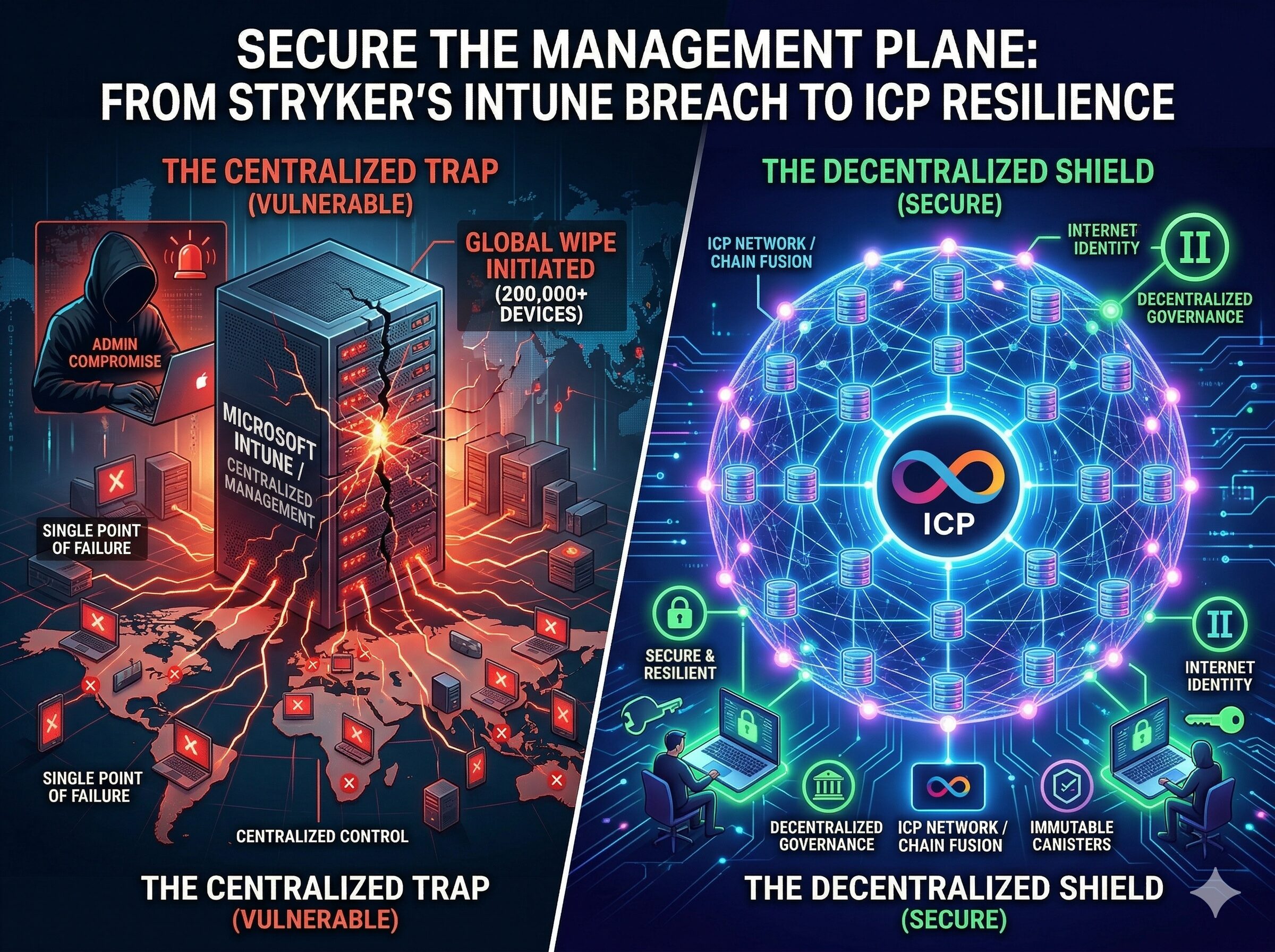
The cybersecurity landscape recently received a stark reminder of the inherent risks embedded within centralized management infrastructure. Following a significant security breach at the global medical technology giant Stryker, the Cybersecurity and Infrastructure Security Agency (CISA) issued an urgent alert to U.S. organizations. The focal point of this warning was not a classic network firewall or an email gateway, but a unified endpoint management (UEM) system: Microsoft Intune.
This incident underscores a fundamental vulnerability in modern enterprise IT—the exploitation of the “management plane” itself. It demonstrates that the very tools trusted to secure and manage devices are often the weakest point in the chain.
The Stryker/Intune Breach: The Danger of a Unified “Kill Switch”
While the specific attack vector of the Stryker breach is still being analyzed, the consequences reveal a dangerous, familiar pattern. Intune is designed to be the central brain for an organization’s entire fleet of devices, managing updates, security policies, software deployment, and conditional access.
When an attacker compromises this management plane (perhaps by compromising a single Global Administrator or Intune Administrator account with inadequate multi-factor authentication), they don’t just “hack a computer”; they gain the proverbial keys to the kingdom.
The attack path is deceptively simple and devastatingly effective:
- Lateral Movement via Policy: An attacker who compromises the Intune tenant can create or modify device configuration policies. Instead of needing to break into each laptop individually, they can push malicious software, deactivate endpoint security (like Microsoft Defender), or execute ransomware scripts across the entire network simultaneously.
- Bypassing Conditional Access: Security teams use Intune to ensure only compliant, trusted devices can access sensitive corporate data. An attacker inside Intune can modify compliance definitions or create a “trusted” rogue device, instantly bypassing these complex defenses.
- The Single Point of Failure: This centralization is the core risk. Intune provides operational efficiency, but it creates a single, catastrophic point of failure. The Stryker breach is what we at ICP Informer call a “centralization tax”—the inevitable cost of relying on a singular vendor’s trust model.
CISA’s “Fix” is a Patched Form of Centralization
In response to the threat, CISA’s guidance focuses on hardening the existing centralized system:
- Enforce Phishing-Resistant MFA: Moving from SMS to FIDO2 hardware keys (YubiKeys) for all administrative accounts.
- Audit Conditional Access Policies: Looking for “allow” rules that are too broad.
- Review Administrative Roles: Implementing the Principle of Least Privilege and “Just-in-Time” access via Microsoft PIM (Privileged Identity Management).
While these are necessary immediate steps for organizations using Intune, they are essentially reactive patches. They make it harder to exploit the single point of failure, but they do not remove the single point of failure itself. The centralized data store, the vendor-controlled cloud, and the inherent dependency on vendor security logic remain.
The Internet Computer (ICP) Vision: Decoupling Trust and Decentralizing the Management Plane
The Stryker/Intune breach is a profound use case for the decentralized cloud model pioneered by the Internet Computer Protocol (ICP). What if the “management plane” itself could be decentralized?
This is how ICP reimagines enterprise security, moving beyond reactive patching to proactive, mathematical trust.
1. Internet Identity (II): Eliminating the Phishable Credential
The vast majority of large-scale enterprise breaches begin with credential compromise (phishing, session hijacking, or password spraying).
ICP addresses this fundamentally. Internet Identity (II) is an inherently secure, anonymous, and cryptographic authentication system. There are no passwords to phish or store in a centralized database. Authentication is bound to physical hardware (e.g., FaceID on a MacBook, YubiKey). A session hijacked from an II-authenticated user cannot simply be reused on another device, blocking the most common first step of an attacker.
2. Decentralized Governance of Policies (Canisters as Policy Engines)
In Intune, a single compromised admin can change a global policy. On the Internet Computer, device management logic would be hosted inside Canister Smart Contracts.
- Immersion in Consensus: These canisters are immutable. Changes to their code or the critical parameters they store (like security compliance rules) are not authorized by one admin.
- DAO-Controlled Rules: Policy changes could require a vote through a Service Nervous System (SNS) or governance proposal. An attacker cannot simply command a change; they must gain consensus from the entire decentralized system (the DAO). This makes policy injection effectively impossible.
3. Threshold ECDSA and the Removal of the “Admin Key”
If an organization wants to integrate the Internet Computer’s decentralized controls with other systems, it can use Threshold ECDSA.
Instead of a single powerful administrative “private key” sitting on a server, that key is mathematically split into shares held by multiple independent nodes. The key is never reconstituted in one place. An attacker who breaches a single point (even a whole node provider) cannot generate an administrative signature to push a malicious policy.
Conclusion: From Defense to Resilience
The Stryker incident proves that the greatest asset of centralized enterprise architecture—the ability to act globally from a single console—is also its fatal flaw.
The Internet Computer provides the only credible architectural path toward building resilient, sovereign management planes. By shifting the foundation of trust from a single vendor’s promise (Microsoft) to mathematical consensus and cryptographic hardware-binding (ICP), organizations are not merely defending themselves; they are architecting resilience.
CISA urges organizations to secure their Intune systems. We urge organizations to start planning for the inevitable move to a decentralized security model where centralized exploits are no longer possible.
Leave a Reply