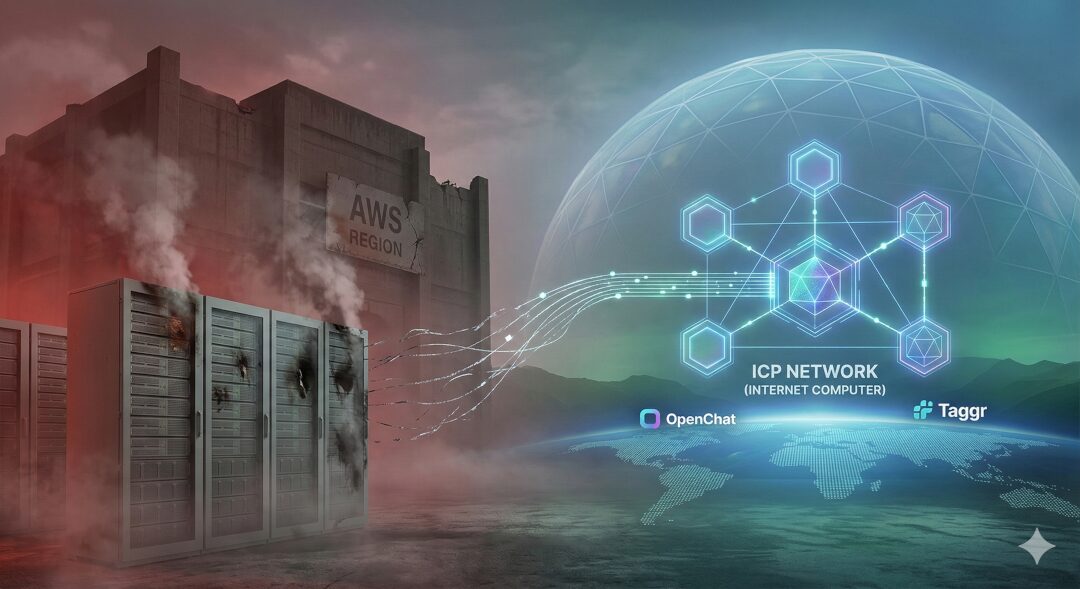
For five years, the DFINITY Foundation and the Internet Computer (ICP) community have championed a single, revolutionary concept: The World Computer. We argued that the future of IT must be hosted on a decentralized, sovereign network, free from the physical and political vulnerabilities of centralized “Big Tech” clouds.
Our warnings were often dismissed by establishment IT architects as academic or overly cautious. Centralized clouds like AWS, Microsoft Azure, and Google Cloud were deemed “too big to fail,” protected by massive budgets and global redundancy.
This month, in the crucible of a rapidly escalating Middle East conflict, that core narrative was violently validated. The centralized cloud failed a critical stress test, and the physical reality of its infrastructure was laid bare.
It is no longer a theoretical debate. The recent AWS outages in the GCC (Gulf Cooperation Council) have proven that the centralized IT model is a single point of failure. The solution is no longer just a crypto innovation—it is a matter of national and economic security.
The GCC Blackout: When Physical Infrastructure Becomes a Target
The ongoing conflict between Iran, Israel, and the U.S. has transitioned from digital espionage to kinetics. On March 2, 2026, a series of coordinated, long-range drone strikes achieved a chilling objective: disabling physical cloud data centers.
Reports confirm that two major Amazon Web Services (AWS) availability zones—the critical me-central-1 region in the UAE and a secondary facility in Bahrain—were directly impacted. The physical server infrastructure, power systems, and cooling loops were compromised, taking them offline.
The cascade was immediate:
- Local Commerce Halted: Major retail hubs across the GCC, from Dubai to Kuwait City, saw payment systems and e-commerce platforms using those local AWS regions fail.
- Web Defacement and DDoS: While the physical infrastructure was down, state-sponsored cyber warfare teams simultaneously launched a wave of over 200,000 DDoS attacks against GCC-hosted domains. Traditional IP-based servers were overwhelmed, causing widespread service collapse even for data centers that were physically intact.
- The Rise of “Sovereign Cloud” Panic: Governments and corporations that once relied on AWS for their digital transformation found themselves suddenly cut off, realizing that “the cloud” is ultimately just a building owned by a foreign (U.S.) entity, situated on volatile ground.
Why Centralized Clouds Are Vunerable
The problem isn’t that Amazon is incompetent; it is that the architectural blueprint of centralized IT is fundamentally flawed for a multipolar, hostile world.
- Geographic Concentration: Big Tech clusters their infrastructure into specific “regions” (e.g.,
me-central-1). Even with multiple “availability zones,” those buildings are often physically close enough to be neutralized by a single regional kinetic event. If a hacker or an army wants to shut down an AWS service, they know exactly which coordinates to target. - A Clear Political Target: AWS, Google, and Azure are proud American giants. In an era of open warfare involving the U.S., their data centers are not seen as “neutral services.” They are seen as extensions of American strategic power and are prioritized military targets.
- The Single Point of Failure: While AWS boasts “redundancy,” it often means they replicate data between their own data centers. If the region is targeted or the Big Tech company itself faces a massive internal failure, all redundant copies fail simultaneously. There is no true, sovereign alternative.
The Case for ICP: How the World Computer Solves the Fragility Crisis
The Internet Computer was engineered from the ground up to prevent this exact scenario. It is a “Full-Stack On-Chain” solution that does not just store data, but runs the actual computation on a decentralized network, making the concept of a physical “region outage” obsolete.
Here is how ICP contrasts with the flawed AWS model:
| Feature | The Flawed AWS Model | The ICP Sovereign Cloud |
| Infrastructure Owner | Centralized U.S. Tech Giant | A network of Independent Node Providers globaly. |
| Resilience | Physical redundancy inside a limited geographic region. | Global Decentralization by default; no single building is critical. |
| Security | IP-based. Vulnerable to DDoS and OS exploits. | Canister Smart Contracts. Secure by design, ignoring standard IP attacks. |
| Security Governance | Managed by the U.S. company; vulnerable to political pressure or targeting. | On-Chain Governance (NNS). Democratic, transparent, and sovereign. |
1. True Decentralization (No Physical Coordinates for Failure)
When an organization deploys a canister smart contract (dApp) on ICP, it isn’t assigned to a server in “Dubai.” Its software state is replicated across multiple independent nodes located in different data centers, in different jurisdictions, and often on different continents, all coordinated by the Network Nervous System (NNS).
If an attacker were to destroy a specific node data center (or even 10 of them), the ICP network simply moves the canister computational state to different nodes in real-time. The application continues to serve web requests without interruption. You cannot bomb the Internet Computer.
2. Full-Stack Sovereignty: “The Sovereign Cloud”
The phrase “Sovereign Cloud” is the defining buzzword in GCC tech circles right now. Organizations are scrambling to move data onto infrastructure that they, not Amazon, control. ICP offers true, full-stack sovereignty.
A canister smart contract on ICP handles everything: the front-end (user interface), the back-end logic, and the user data. It is served directly from the canister as a tamper-proof web service. GCC organizations using ICP could achieve true computational sovereignty, knowing that no external entity—corporate or political—can access their data or shut down their service.
3. DDoS Immunity: The Proof is in the Protocol
Traditional web architecture uses standard HTTP/IP stacks that are easy to flood with artificial traffic (DDoS). ICP operates on a cryptographic protocol that is highly resilient to these volumetric attacks. Canisters ignore invalid or flooded traffic at the protocol layer, allowing legitimate requests (like using OpenChat or Taggr) to proceed normally, even while standard sites in the same city are being taken offline.
Conclusion: A Wake-Up Call for IT Architects
The events of March 2026 are a definitive wake-up call. The centralized IT infrastructure of the past has failed to keep pace with the physical and cyber threats of the modern world. For the GCC, the cost of relying on AWS was measured in economic halts and infrastructure damage.
The Internet Computer is no longer an optional “Web3 experiment.” It is the architectural necessity of our time. It is the only platform that delivers the resilience, sovereignty, and security required to build a truly unbreakable digital future.
IT decision-makers and governments globally must now ask: Is our digital world built on sand (the centralized cloud), or is it secured by the protocol-based sovereignty of the Internet Computer?
The time for waiting is over. The case for ICP is complete.
About ICP Informer Our mission is to track the projects, technological breakthroughs, and macroeconomic shifts driving the transition to a Full-Stack On-Chain future.
Leave a Reply