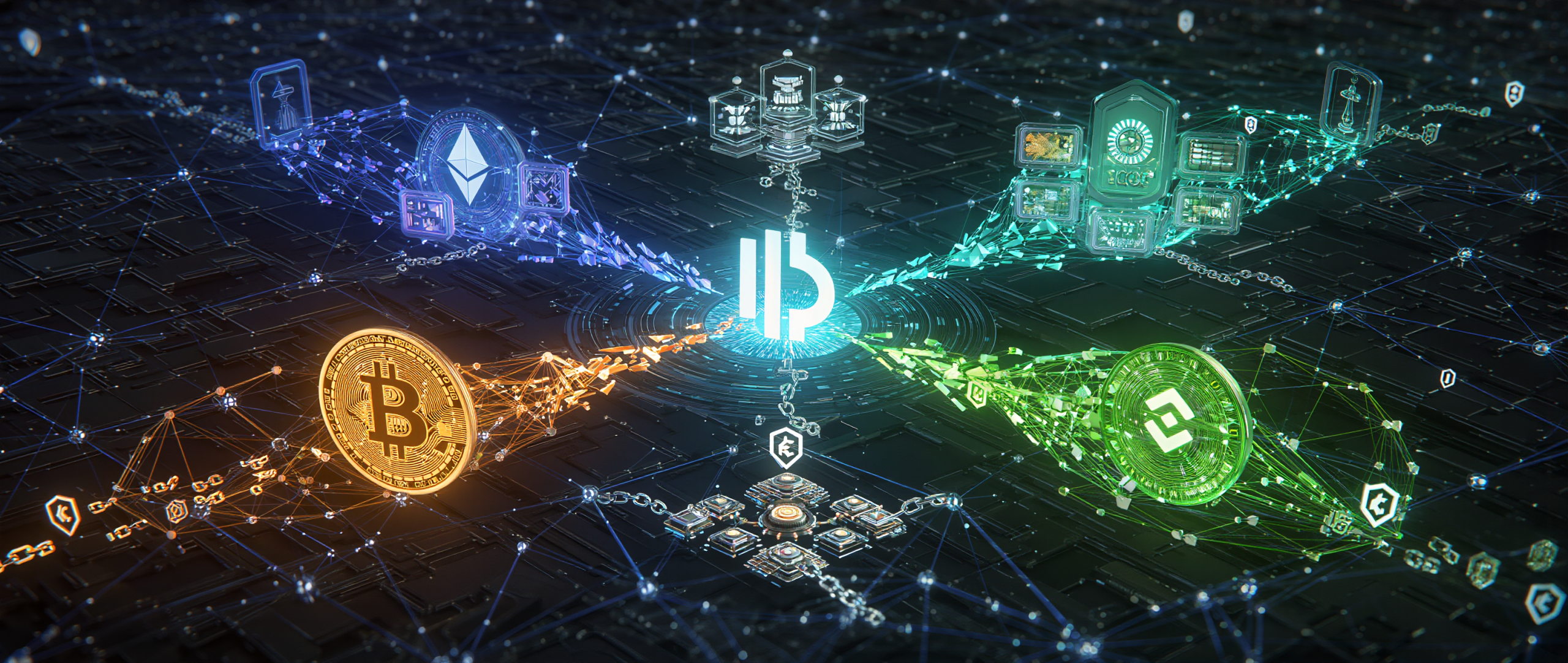
The blockchain world remains fragmented. Assets, liquidity, and users stay siloed across networks like Bitcoin, Ethereum, and Solana. Traditional bridges introduce centralization risks, security vulnerabilities (with billions lost to hacks), and friction that undermines the decentralized ethos. Internet Computer Protocol (ICP) addresses this through its groundbreaking Chain-Key Fusion technology (built on Chain-Key Cryptography). This innovation fuses multiple blockchains into a cohesive, trustless ecosystem where smart contracts on ICP can natively interact with, hold assets from, and augment other chains.
Chain-Key Fusion positions ICP as more than another Layer-1. It acts as a “world computer” that scales infinitely, hosts full-stack dApps on-chain (including frontends and AI), and delivers web-speed performance while securely bridging the multi-chain universe. This pillar content explores the technology’s features, benefits, real-world integrations, and future roadmap.
Understanding Chain-Key Cryptography: The Foundation
Chain-Key Cryptography serves as the cryptographic engine powering ICP. Subnets (independent blockchain shards that scale the network) jointly hold keys through advanced threshold signature schemes (such as BLS and ECDSA variants). No single node or small group of nodes can control or misuse the key—only a majority of honest nodes can act together.
Key innovations include:
- A single public key for the entire Internet Computer: Any device (even a smartphone or smartwatch) can verify ICP artifacts instantly without downloading blockchain history.
- Distributed key generation and re-sharing: Keys are split into shares across nodes. The network can add/remove nodes or form new subnets without downtime or compromising security.
- Certified responses and unbiased randomness: Smart contracts (called canisters) produce verifiable outputs and access unpredictable randomness for applications like lotteries or AI.
These capabilities enable ICP’s horizontal scalability (add nodes/subnets to increase capacity indefinitely), low-latency finality (~2 seconds), and the ability for canisters to perform operations that traditional blockchains cannot, such as signing transactions on external chains.
Chain Fusion: Fusing Blockchains into One Experience
Chain Fusion builds directly on Chain-Key Cryptography to create decentralized, bidirectional interoperability. Canisters on ICP can:
- Read state from other blockchains.
- Sign and submit transactions on those chains.
- Hold and control native assets.
This eliminates trusted bridges or intermediaries. It achieves this through two core mechanisms:
- Chain-Key Signatures (Threshold Signing): Canisters derive addresses and sign transactions (e.g., Bitcoin or Ethereum) using distributed private key shares. The full private key never exists in one place.
- Bi-Directional Communication: Native P2P integration for Bitcoin (ICP nodes act as Bitcoin nodes via adapters). HTTPS outcalls to reliable JSON-RPC providers for Ethereum and EVM-compatible chains (with plans and support expanding to others like Solana).
The result? Multi-chain dApps that feel like single-chain experiences. Developers build on ICP’s superior compute, storage, and speed while tapping liquidity and features from other ecosystems.
Core Features of Chain-Key Fusion Technology
- Chain-Key Tokens (ckTokens): These are 1:1 backed “digital twins” of native assets, fully controlled by ICP canister smart contracts. Examples include ckBTC, ckETH, ckUSDC, and ckUSDT. Unlike centralized wrapped tokens, everything runs on-chain with no custodians—minting occurs when users send native assets to a controlled address, and burning/redeeming works in reverse. Transactions on ICP are fast and cheap (often sub-cent fees with web-speed finality).
- Native Asset Control: Canisters directly manage addresses on external chains (e.g., Bitcoin UTXOs or Ethereum accounts).
- Cross-Chain Orchestration: An ICP canister can listen to events on Ethereum, execute complex logic or AI inference on ICP, then trigger a Bitcoin transaction—all trustlessly.
- Scalable Subnet Architecture: Fusion works across ICP’s growing network of subnets, preserving decentralization and performance as the system expands.
Key Benefits of Chain-Key Fusion
Unmatched Security: Threshold cryptography removes single points of failure and bridge exploits. Assets stay under decentralized control.
Superior Performance and UX: ICP delivers web-like responsiveness. Users interact with multi-chain assets without bridging delays, high gas fees, or complex wallet switches. End users often pay no gas (prepaid via cycles by developers).
Infinite Scalability and Cost Efficiency: Add nodes to grow capacity. Hosting 1GB of data costs ~$5/year, making data-heavy or AI applications viable on-chain.
Developer Empowerment: Build full applications (backend, frontend, storage, AI) entirely on-chain while accessing other chains’ liquidity. No more compromising on security or performance for interoperability.
Ecosystem Synergies: ICP augments other blockchains. Bitcoin gains smart contract programmability and DeFi; Ethereum gains ICP’s speed and on-chain hosting; the whole multi-chain world becomes more composable.
Privacy and Sovereignty: Advanced cryptography supports encrypted on-chain data, aligning with sovereign cloud and decentralized identity goals.
Integrations with Other Cryptocurrencies: Real Examples
Bitcoin Integration
ICP nodes connect directly to Bitcoin’s P2P network. Canisters control BTC addresses and sign transactions using chain-key ECDSA/Schnorr.
- ckBTC: The flagship chain-key token. Users send BTC to a canister-controlled address → receive ckBTC on ICP for fast DeFi (lending, DEX trading, yield farming). Redeem 1:1 for native BTC anytime.
- Use Cases: Bitcoin-native DeFi (order-book DEXes like Helix Markets), Ordinals/Runes marketplaces (e.g., Bioniq), microtransactions in apps like chat platforms, and memecoin launches (e.g., Odin.Fun processing high-volume trades with ckBTC). This brings programmable Bitcoin liquidity directly into ICP’s ecosystem without custodians.
Ethereum and EVM Chains
Via HTTPS outcalls and chain-key signatures, canisters query Ethereum state and submit signed transactions.
- ckETH and ckERC20: 1:1 twins for ETH and tokens like USDC/USDT.
- Examples: Trustless BTC-ETH swaps in seconds for pennies. ICP canisters triggering Ethereum smart contracts or using ICP’s compute to enhance EVM dApps. Projects build on-chain wallets (e.g., Oisy, a multichain browser wallet powered by Chain Fusion) and cross-chain oracles. Developers access any EVM chain via tools like the EVM RPC canister.
Solana and Expanding Ecosystem
Solana integration (via the Helium milestone) brings high-throughput assets and programs into the fold. Canisters interact natively, combining Solana’s speed with ICP’s full-stack capabilities for seamless dApps.
Broader Impact: A DEX on ICP can hold liquidity pools in BTC, ETH, SOL, and stables simultaneously. Users trade across chains from one interface. DAOs control multi-chain treasuries. AI models on ICP process cross-chain data in real time.
Adoption continues to grow, with ckTokens enabling billions in potential TVL across DeFi protocols, wallets, and applications that leverage native multi-chain flows.
Future Plans and Development Roadmap
ICP’s roadmap (updated through 2025–2026 and beyond) prioritizes Chain Fusion expansion as a core theme. Key upcoming and ongoing developments include:
- Meridian Milestone (targeted around late 2025): Dogecoin integration, further expanding meme and community-driven asset support.
- More Chains and Enhanced Primitives: Broader EVM support, improved signing services (e.g., Chain Fusion Signer canisters), and easier developer tools for any compatible blockchain.
- AI Synergies: On-chain AI inference and “self-writing internet” capabilities (via milestones like Vertex and Caffeine) combined with Chain Fusion. Imagine decentralized AI agents that orchestrate actions across Bitcoin, Ethereum, Solana, and ICP in real time—executing trades, generating content, or managing assets autonomously and securely.
- Performance and Scalability Upgrades: Reduced latency, increased storage/throughput, and immutable blob storage to support even larger multi-chain applications.
- Wallet and User Experience: Advancements like Oisy v1.0 and multi-custody frameworks (Orbit) make multi-chain interactions intuitive for everyday users.
- Long-Term Vision: DFINITY and the community aim for a true World Computer where Chain-Key Fusion makes blockchain silos obsolete. Developers build sovereign, censorship-resistant applications that leverage the best of every chain while running at internet scale.
These developments, combined with tokenomics improvements and governance enhancements, position ICP for mainstream adoption in DeFi, AI, social, gaming, and enterprise.
Conclusion: The Dawn of the Fused Blockchain Era
Chain-Key Fusion Technology represents one of the most significant advancements in blockchain since the invention of smart contracts. By solving interoperability securely and at web speed, ICP doesn’t just connect chains—it fuses them into a more powerful, scalable, and user-friendly whole.
For developers, it opens unprecedented possibilities: Build once on ICP and tap global liquidity and features across ecosystems. For users, it means simpler, safer, faster experiences without bridge anxiety. For the industry, it accelerates the shift toward a truly decentralized, multi-chain internet.
As integrations expand (Bitcoin, Ethereum, Solana, Dogecoin, and more) and AI capabilities mature, Chain-Key Fusion will drive the next wave of innovation. The Internet Computer is not competing with other blockchains—it is elevating them.
Explore the technology yourself: Deploy a canister, mint some ckBTC, or follow developments on icpinformer.com. The fused future of crypto is here—built on ICP’s Chain-Key technology.
Leave a Reply